90 Seconds to Disaster: The Herald of Free Enterprise
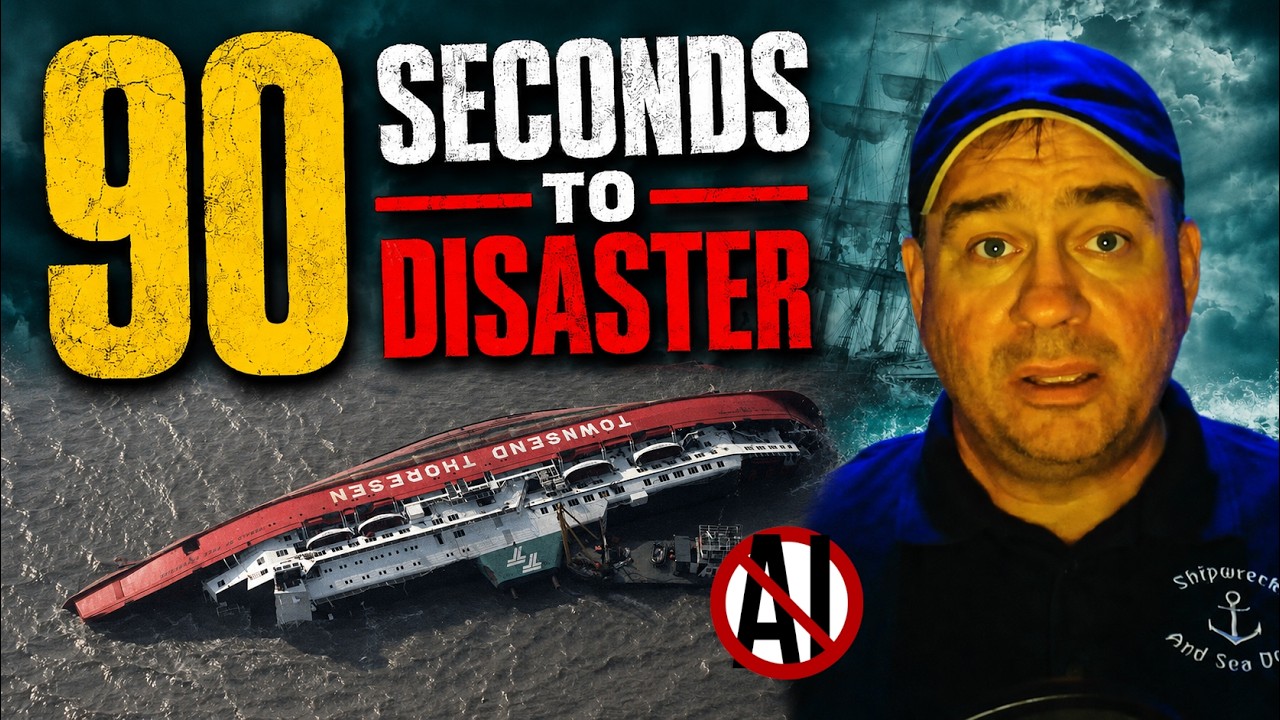
The passenger and vehicle ferry sank 6 March, 1987 after its bow door was left open.


The Herald of Free Enterprise: How a Routine Ferry Crossing Became One of Britain's Deadliest Peacetime Disasters | Shipwrecks and Sea Dogs
On the night of March 6, 1987, the roll-on/roll-off ferry Herald of Free Enterprise left the Belgian port of Zeebrugge bound for Dover with nearly 500 passengers and crew aboard. Minutes after clearing the harbor, the ship rolled onto its side in shallow water, claiming 193 lives in one of the most consequential maritime disasters of the 20th century. In this episode of Shipwrecks and Sea Dogs, host Rich Napolitano traces the chain of small failures, design flaws, and operational pressures that turned a routine cross-Channel run into catastrophe. Topics discussed include the open bow doors that let the North Sea pour onto the car deck, the free surface effect that capsized the ship in under two minutes, the frantic rescue effort in freezing water, and the Sheen Inquiry that famously diagnosed the ferry operator's culture as suffering from a "disease of sloppiness." This disaster reshaped international maritime safety law and changed RO-RO ferry future designs.
**🎧 LISTEN AD-FREE + BONUS EPISODES**
👉Shipwrecks and Sea Dogs is part of the Into History podcast channel — subscribe here: https://www.intohistory.com/shipwreckspod
👉Get exclusive bonus episodes and merch on Patreon: https://www.shipwrecksandseadogs.com/patreon
👉Subscribe on Apple Podcasts: https://www.shipwrecksandseadogs.com/apple
👉Shipwrecks and Sea Dogs Merchandise is available! https://shop.shipwrecksandseadogs.com
👉You can support the podcast with a donation of any amount at: https://www.buymeacoffee.com/shipwreckspod
#HeraldOfFreeEnterprise #ShipwreckHistory #ZeebruggeDisaster #MaritimeDisaster #FerryDisaster #MaritimeHistory #NauticalHistory #HistoryPodcast #ShipwrecksAndSeaDogs #Townsend #Thoresen
** No AI was used to create this video.
Written, edited, and produced by Rich Napolitano. All episodes, images, and sources can be found at shipwrecksandseadogs.com.
Original theme music by Sean Sigfried. https://www.seansigfried.com
You can also listen to Shipwrecks and Sea Dogs podcast on Spotify, Apple Podcasts, or wherever you listen to podcasts. https://www.podfollow.com/shipwreckspod
It’s March 6th, 1987. The ferry Herald of Free Enterprise has just departed Zeebrugge, Belgium, bound for Dover, England across the Strait. Sixteen year old Gillian Lashbrooke is taking the trip across the narrow waterway with her mother, stepfather, three stepbrothers, and her uncle.
Despite a cold strong, wind she stands outside on the deck, leaning over the rail and looking down into the water. The water seems to be getting further away — at first she thinks she is imagining it. Suddenly, the ship tilts underneath her, and she is flung backwards, knocking her unconscious. When she regains her senses, she is lying on the outdoor seats, but they are in the wrong place. The ship has gone onto its side, and the floor is now like a wall. She tries to climb up the seating like a ladder but cannot manage it. She desperately tries to get inside to check on her mother and family.
But it is no use. She cannot make the climb. As the ship continues to roll over, she is forced to leap into the frigid water of the English Channel. Wearing long boots and a denim coat, she quickly understands she is at risk of being dragged under. WHile still trying to swim and stay afloat, she fights with her boots and coat but finally shed them.
Her first thought is to swim to land. They were just outside the harbour, she thinks, and land is so near. But the water is too bitterly cold, and the waves and wind ferocious. She will never make it. Turning back, the young lady swims to the boat, and hooks her skirt onto a piece of metal protruding from the hull to keep herself from being pulled under. Nearby, a woman is holding a small girl above the waterline. Helicopters circle overhead but she cannot see them. Realizing she must make herself visible to be rescued, she flings herself back into the sea, where she spots a fishing boat. Behind her, she hears the woman screaming, begging not to be left to die. Gillian shouts back that she will tell the rescuers where the woman is. She is quickly pulled into the fishing boat, and whisked to safety. What became of the woman and the little girl, she will never know.
Back on land, an ambulance takes her to hospital. She thinks to herself, “tonight, I became an adult.” She washes her clothes in the sink and puts them on a radiator to dry. She then prays for her mother, still not knowing what has happened to her or her extended family.
The following day she is reunited with her stepbrothers, and learn their parents are dead. The siblings are shuffled into a gymnasium that has been transformed into a makeshift morgue. Dozens of bodies lie on the floor. A dreadful sight.
All around, bodies of men, women, and children are laid out — children she had seen alive the evening before. Gillian spots her stepfather immediately. Then her brother finds their mother. Gillian is stunned with shock and cannot believe she is looking at her mother’s dead body. She loves her so much, and she is dead in front of her. She is not just her mum — she is her best friend. The night before, just before going up on deck, Gillian’s mum pressed some money into her hand and said, “get something to eat love, and I'll see you in a minute.” That minute never came. That is the last time Gillian saw her mother alive.
This is a narrative of the first hand account of survivor Gillian Lashbrooke, whose mother, stepfather, and uncle perished on board the Herald of Free Enterprise, on the 6th of March, 1987.
Disaster at Zeebrugge: The Herald of Free Enterprise, today on Shipwrecks and Sea Dogs.
The English Channel, or as the French call it, La Manche, separates the southern coast of England and the northern coast of France. This natural barrier between the two countries has been a strategic and symbolic barrier between the British Isles and Continental Europe for centuries. Now one of the busiest waterways in the world, it provides access to ports such as Portsmouth, Southampton, Le Havre, Cherbourg, Dover, and Calais, as well as passage to the North Sea.
The narrowest portion of the Channel is between Dover on the English side, and Calais on the French side, just 20 miles, or 33 kilometers. This portion of the Channel is called the Dover Strait in England, and the Pad de Calais in France. While boats and ships have been crossing the channel for thousands of years, the first ever regular passenger ferry service across the channel was the paddle-steamer Rob Roy, named after the Scottish folk-hero. Built by famed shipbuilder William Denny in 1818, the Rob Roy is considered the first steam-powered vessel to complete an open-sea voyage, sailing from Glasgow to Dublin. After providing regular service between Scotland and Ireland, the vessel was sold to the French Postal Administration in 1821. Its maiden crossing with passengers was in 1822, carrying just a handful of passengers and a cargo of mail. In 1823 the Rob Roy was renamed to Henry IV. Its first crossing with passengers took place in 1822, making the trip in three hours.
This pioneering ferry service was proof-of-concept that a ferry could provide regular service across the channel, and more routes developed over time.
The Townsend Shipping Company created the first automobile ferry service between Dover and Calais in 1928, using the chartered ship, the “Artificer” (AR-tuh-FISS-ur). The vessel could carry up to fifteen vehicles, which were loaded and unloaded by crane, as well as twelve passengers.
The use of the LST, short for Landing Ship, Tank, during World War II influenced the development of the commercial roll-on/roll-off ferry, or RO-ROs. These vessels are designed to allow vehicles to simply drive on and off using ramps, rather than being lifted by cranes. The first RO-RO ferry to cross the English Channel was in 1953, once again put into service by Townsend. Automobile usage and the growth of truck freight surged following World War II, and millions sought to take their vehicles on an affordable holiday across the channel.
Trucks, cars, buses, and trailers can be loaded and unload extremely quickly using RO-Ros. Higher efficiency means quicker turnarounds, resulting in higher profits, and ferries began to be built even larger to accommodate more vehicles and more passengers. Over the decades, the ports of Dover and Calais underwent continual growth and development to handle the demand.
The 1970s saw an enormous expansion in Ro-Ro ferry traffic between Dover and Calais. It transformed the English Channel from a traditional passenger sea route into one of the world’s busiest vehicle and freight corridors.
In 1977, Townsend Car Ferries, Inc, a division of Townsend Thoresen, ordered three new identical RO-RO ships for its Dover–Calais service. These were dubbed “Spirit-class”, and were named: Spirit of Free Enterprise, Herald of Free Enterprise, and Pride of Free Enterprise. Townsend Thoreson, a corporate-merger descendant of Townsend Shipping, was one of the busiest operators on the Dover Strait at the time.
The Herald of Free Enterprise was built in 1980 by Schichau Unterweser of Bremerhaven, Germany. A large triple-screw roll-on/roll-off passenger and vehicle ferry, she was just over 131 metres in length and 22.7 metres across her beam. She was a substantial ship for her time, with a gross tonnage of 7,951, and powered by an impressive propulsion system built for both speed and reliability to keep up with tight ferry schedules.
With a top speed of 22 knots, the Herald of Free Enterprise was well suited to the demanding routes across the Dover Strait. She was also equipped with modern, comprehensive navigation and communications systems, to meet the challenges of the busy waterway.
Up to two-hundred vehicles could be housed in decks D, E, and G. Passengers areas were located on decks B and C, with a capacity of up to 1400 people. Decks A, F, and H, were reserved for crew, the ship’s engines, galley, and other equipment.
Safety on the Herald of Free Enterprise was not an oversight. The vessel carried 8 Lifeboats, 7 Throwover liferafts, 5 Buoyant apparatus, 20 Lifebuoys and 1,525 Lifejackets, including 139 for children. The vessel also had a Marine Evacuation System on each side of D-Deck, with escape chutes leading down to eight inflatable liferafts.
The lifesaving equipment on board the Herald not only met, but exceeded the regulations of the time.
On March 6th, 1987, the Herald of Free Enterprise was docked at the number twelve berth at Zeebrugge (ZAY-bruh-kuh), Belgium, preparing for a voyage to Dover. This was not her usual route, and the linkspan, or drawbridge, from the dock to the ship could only accommodate one deck at a time. Since the Herald stored vehicles on three decks, it was necessary to fill its ballast tanks to lower the vessel sufficiently for the ramp to align with its vehicle decks.
The preparation for departure at Zeebrugge differed greatly from its usual port at Calais. With only one vehicle deck at a time being loaded, it took longer to load all the vehicles. The duties of the deck officers and crew had to be split up differently, creating a greater chance for error. The passage between Dover and Zeebrugge takes four and a half hours, substantially longer than the passage between Dover and Calais. This gives the officers more time to relax, and for this reason, the company arranged for a Master and just two deck officers on this run, rather than three.
A set of outer and inner doors were located at the bow and stern, which were opened and closed during the loading and unloading of vehicles. The hydraulic doors were made watertight with neoprene seals, and secured with hydraulically operated clamps and dogs. The proper closure and sealing of these watertight doors is absolutely critical for RO-RO vessels.
The weather at Zeebrugge was poor that day. A force 6 wind between 25-31 miles per hour blew across the harbour approaches. The sea beyond the port’s breakwater was rough and cold, with frothy whitecaps dotting the seascape. Inside the ferry terminal, loading operations continued at a frantic pace. Freight vehicles and passenger cars streamed aboard while crew members rushed through familiar departure routines.
Under command of the ship’s Master, Captain David Lewry, the vessel carried eighty crew, 459 passengers, 81 cars, three buses, and 47 trucks. At approximately 6:00 PM, Lewry called for “Harbour Stations”, the signal to all crew to report to their assigned stations for departure. The Herald slowly pulled away from its berth at 6:05 PM, only five minutes behind schedule. A harbour tug guided the vessel and it slowly moved through the inner harbour at 5 knots.
While not at full capacity, many of the passengers on board had taken advantage of an offer in The Sun newspaper, offering travel on the Herald for just one pound. While a few braved the cold out on the open deck, most stayed indoors. Families gathered for a bite to eat at the ship’s restaurant on C deck, while others casually chatted, or shopped for deals at the on-board duty free shop. With 47 trucks on board, their drivers mostly sought the sleeping quarters to get some rest, or a shower and a hot meal. There was little reason to believe the trip to Dover would be any different from any other Channel crossing.
After passing the outer mole at 6:24 PM, the Herald entered the open sea, and Lewry accelerated to between 16 and 18 knots. Passengers gazed out of the windows at the lights and activity of Zeebrugge, as the vessel moved further out to sea.
Almost immediately after picking up speed, seawater flooded the lower vehicle deck. This deck stretched almost uninterrupted from one side of the ship to another, and the water spread instantly across the ship’s breadth. The effect was catastrophic. The ferry began to list sharply to port, then to starboard, then back to port.
Passengers noticed an unusual vibration in the ship and were concerned when the vessel suddenly turned. Drinks slid across tables. Chairs toppled. And people screamed in alarm.
Down below, vehicles broke loose from their lashings, and heavy trucks shifted across the deck as water continued pouring into the hull. The angle of the list increased so rapidly that there was no time to react. Captain Lewry issued ordered a mayday distress, which communicated the ship’s significant list and immediate danger. The call was received by nearby ships and on-shore radios, setting the rescue operation in motion very quickly.
The Herald’s lights failed almost immediately as incoming water snuffed out the generators. Darkness swept through the vessel leaving passengers and crew scrambling around in confusion. Screams echoed through overturned corridors, which were filling with frigid seawater. Furniture, luggage, and debris crashed aimlessly through the interior.
In less than two minutes, the Herald rolled onto her port side. There was no time to launch any of the lifeboats or distribute lifejackets. The Herald of Free Enterprise came to rest in shallow water; the sudden turn to starboard felt by the passengers prevented the vessel from sinking in much deeper water.
Some passengers managed to climb upward through the tilted ship toward broken windows or emergency exits above the waterline. Others became trapped inside submerged compartments as frigid water surged through the ferry. Those who could, climbed to the top of the now overturned vessel, standing on the upturned starboard side of the vessel.
Outside, witnesses in Zeebrugge could scarcely comprehend what they were seeing. The massive ferry had capsized only a short distance from the port, partially submerged in shallow water, her hull lying on its side with part of the superstructure still visible above the sea.
The dredger Sanderus was nearby on the western side of the channel. Its crew had observed the ferry pass her just a short time earlier, and then heel over to port. The Sanderus notified Port Control Zeebrugge on the VHF radio and immediately set out towards the Herald to assist.
Belgian authorities, tug crews, nearby vessels, helicopters, and emergency services converged on the wreck. Survivors clung to the exposed side of the hull or huddled inside air pockets within the overturned ship while rescuers smashed through windows and cut openings into the steel structure.
By 7:25, Belgian divers had arrived on scene to begin underwater search and rescue. By 9:00, most of the exposed windows on the starboard side leading to the interior of the Herald had been smashed open, and people inside were pulled out. The lack of proper lighting, the number of rescuers on board, the panic and screams for help, and the excessive noise from rescue vessels and helicopters made communications difficult.
By all accounts, the surviving crew of the Herald responded admirably to the disaster. From the time of the capsizing, they initiated the breaking of windows and lowering of ropes and ladders to haul up passengers. Suffering from cold and shock themselves, they had to be persuaded to board the vessel BURGERMEESTER VAN DAMME. Many wished to return to the Herald and continue to assist with the rescue.
Reporters, who had jumped aboard the tugs FIGHTER and RIVER TAMAR in Zeebrugge, against the wishes of the Masters, managed to board the Herald and immediately interfered with rescue operations. They refused to leave until authorities threatened to physically remove them.
Rescue operations continued into the early morning hours, with divers listening for the hammering of any survivors that might be trapped below decks. Remarkably, at 1:15 AM, almost five hours after the capsizing, three survivors were found in the forward crew accommodation.
Despite the quick response and the Herald’s close proximity to shore, the freezing water and darkness made rescue extraordinarily difficult. Many victims succumbed to hypothermia within minutes.
Thirty-two vessels from five different countries assisted in the rescue operations, including the Belgian Navy, French Navy, British Royal Navy, German Navy, and the Royal Netherlands Navy.
Despite the fast response of rescue vessels, ultimately 135 passengers and 58 crew lost their lives.
The sinking was a shock to all of Europe, and the world. The Herald of Free Enterprise, a mainstay among the vessels crossing the Channel, had capsized within sight of shore during a routine departure on one of the busiest ferry routes in the world. The public, especially grieving families, wanted answers.
A Court of Inquiry was established to conduct a formal investigation into the loss of the Herald of Free Enterprise. Headed by Sir Barry Sheen, the investigation was conducted over 29 days between April and June of 1987, and its findings were published in July of 1987. Commonly known as the Sheen Report, it exposed significant and systemic problems within the ferry industry, Townsend’s company management culture, and design assumptions behind roll-on/roll-off passenger ferries.
The inquiry found that the immediate physical cause of the sinking was straightforward: the ferry departed Zeebrugge with its bow doors open.
As the ship accelerated out of the harbour on the evening of March 6th, 1987, seawater poured through the open bow entrance onto the lower vehicle deck. Because Ro-Ro ferries have long, open car decks extending almost the entire width and length of the ship, the water spread rapidly from side to side. This created what naval architects call the “free surface effect,” which destroyed the vessel’s stability within moments. The ferry capsized approximately 90 seconds after water entered the vehicle deck, leaving virtually no time for officers and crew to react.
While the immediate cause of the sinking was very clear, the Sheen Report emphasized far deeper root causes.
It was the assigned duty of Assistant Bosun Mark Stanley to close the bow doors prior to departure. Stanley opened the doors upon arrival at Zeebrugge earlier in the day, and then went about supervising members of the crew as they performed usual maintenance and cleaning of the ship. After being released from work by the Bosun, Mr. Terrence Ayling, Stanley went to his cabin for a brief rest, and fell asleep.
Mark Stanley was not awakened by the call to Harbour Stations, and failed to report to his station to close the doors to the vessel’s vehicle deck prior to departure.
When the last vehicle was loaded onto G Deck, Bosun Terrence Ayling attached a chain across the vehicle entrance and departed the area. When Ayling was asked whether there was any reason why he should not have shut the doors, he replied “It has never been part of my duties to close the doors or make sure anybody is there to close the doors.” He also said “At that stage it was harbour stations so everybody was going to their stations.” The Court wrote of Ayling, “He took a narrow view of his duties and it is most unfortunate that that was his attitude.” However, the report does give praise to Mr. Ayling’s role after the vessel capsized, stating, “In the absence of any deck officer he took the responsibility for organizing the rescue efforts, first from the bridge and later in the passenger spaces.”
The Court was also complimentary of Assistant Bosun Mark Stanley, despite his failures, writing “In fairness to Mr. Stanley it is right to record that after the HERALD capsized he found his way out of the ship and on to her hull where he set about rescuing passengers trapped inside. He broke a window for access and, when he was scooping the glass away his right forearm was deeply cut. Nevertheless he re-entered the hull and went into the water to assist passengers. He continued until he was overcome by cold and bleeding.”
The role of First Officer Leslie Sabel was of particular interest to the Court of Inquiry. Sable was also on the vehicle deck overseeing operations prior to departure. When the call for Harbour Stations was given, Sabel departed for the bridge, assuming Stanley would be arriving any second to secure the doors. Townsend had issued a general instruction in 1984, that it was the duty of the officer loading the main vehicle deck to ensure that the bow doors were secure when leaving port. The investigation uncovered that this instruction had been regularly ignored, and not just on the Herald of Free Enterprise.
Sabel gave an initial deposition on April 1, 1987, stating, “I then checked that there were no passengers in the bow area likely to come to harm, and ensured that there was a man standing by to close the bow doors, I do not remember who he was. Having ascertained everything was in order on the car deck, I went to the bridge, which was my harbour station, assisting the Master”.
But Sabel gave a slightly different and contradictory statement before the Court. He claimed to have seen a man on G Deck, who he assumed was Assistant Bosun Mark Stanley coming to close the doors. He described passengers being on the deck, (contrary to his earlier statement) and that he was distracted.
The inquiry found Sabel’s testimony both unreliable, confused, and troubling, and issued extremely harsh criticism, writing, “The probability is that he left the area of the bow doors at a time when there was no one on G deck. It is likely that at that time he felt under pressure to go to the bridge, because that was his harbour station, and that he had confidence that Mr. Stanley would arrive on G deck within a few moments. Mr. Sabel has carried out this operation on many occasions. Mr. Sabel failed to carry out his duty to ensure that the bow doors were closed. He was seriously negligent by reason of that failure. Of all the many faults which combined to lead directly or indirectly to this tragic disaster that of Mr. Leslie Sabel was the most immediate. This Court cannot condone such irresponsible conduct. For this reason his certificate of competency must be suspended.”
Fault was found with Captain David Lewry as well, who assumed the doors had been closed, without confirming it was done. The Court criticized Lewry, writing, “The fact that other Masters operated the same defective system does not relieve Captain Lewry of his personal responsibility for taking his ship to sea in an unsafe condition. In so doing he was seriously negligent in the discharge of his duties. That negligence was one of the causes contributing to the casualty. The Court is aware of the mental and emotional burden resulting from this disaster which has been and will be borne by Captain Lewry, but the Court would be failing in its duty if it did not suspend his Certificate of Competency.”
The Court argued that unsafe operational habits had become normalized within the company. Procedures that should have been rigidly enforced were instead treated casually or ignored completely. Crew members often worked under intense pressure to maintain schedules and perform rapid turnarounds, particularly on the highly competitive Dover Strait routes.
Several overall flaws were found in the company’s operation of its fleet, citing poorly defined responsibilities for both officers and crew, assumptions routinely being acceptable in place of direct confirmation, and management’s failure to consistently enforce safety regulations. The court identified disturbing patterns within the Townsend Thuresen organization, finding the company had ignored repeated requests for improved safety systems, failed to respond adequately to concerns raised by officers, and prioritized commercial efficiency over operational safety.
One particularly important finding involved repeated requests from captains for bridge indicator systems showing whether bow and stern doors were closed. Such systems had been proposed before the disaster, but management had not treated them as necessary. This was further evidence of a broader corporate attitude in which operational speed and maintaining its schedule took precedence over risk reduction.
Inherent vulnerabilities in the design of roll-on/roll-off ferries were also highlighted. The inquiry demonstrated that only a relatively shallow depth of water on the car deck was needed to destroy stability. Although the Herald of Free Enterprise complied with existing regulations, the disaster revealed the potential dangers of free surface flooding on open vehicle decks.
In consideration of the evidence and testimony, the Court of Inquiry issued its decision: “The court, having carefully inquired into the circumstances attending the above-mentioned shipping casualty, finds, for the reasons stated in the Report, that the capsizing of the HERALD OF FREE ENTERPRISE was partly caused or contributed to by serious negligence in the discharge of their duties by Captain David Lewry (Master), Mr. Leslie Sabel (Chief Officer) and Mr. Mark Victor Stanley (Assistant bosun), and partly caused or contributed to by the fault of Townsend Car Ferries Limited (the Owners). The court suspends the certificate of the said Captain David Lewry for a period of one year from the 24th July 1987. The Court suspends the certificate of the said Mr. Leslie Sabel for a period of two years from the 24th July 1987.
Perhaps the most memorable phrase in the report was Sheen’s condemnation of the systemic problems uncovered within Townsend Thoreson: Sheen concluded: “From top to bottom the body corporate was infected with the disease of sloppiness.”
The Herald of Free Enterprise and the subsequent investigation led directly to major changes in international maritime safety. Reforms included:
* mandatory bridge indicators for bow and stern doors,
* improved watertight integrity standards,
* stricter departure checklists,
* enhanced evacuation procedures,
* and revised stability requirements for Ro-Ro ferries.
The disaster also accelerated international amendments to the International Maritime Organization SOLAS (Safety of Life at Sea) convention.
The Sheen Report remains one of the landmark accident investigations in maritime history because it shifted focus away from simply blaming individual operators and toward examining organizational culture and systemic failure. It became a foundational case study in modern transportation safety management.
Townsend Thoresen suffered from the massive negative press surrounding the loss of the Herald of Free Enterprise. Its parent company, P & O European Ferries, dissolved Townsend Thoresen, and all Townsend vessels were repainted to reflect the P & O brand. Animosity was fueled further when it was learned that Townsend Thoresen refused to even speak to some of the surviving crewmembers, refused to pay for travel for those attending the inquiry and coroner’s inquest, and only offered surviving crew compassionate leave if it was deducted from their annual leave entitlement, among many other perceived slights and thoughtless gestures.
Despite all of this, Prime Minister Margaret Thatcher made P & O chairman Sir Jeffrey Sterling the Baron of Plaistow (PLASS-tow) in 1991, and he was given a seat in the House of Lords. Ironically, Stirling had been knighted in 1986, a year prior to the Herald of Free Enterprise disaster, for “public service and services to industry.”
In 1989, British prosecutors brought charges of corporate manslaughter against P&O European Ferries, along with several senior employees. This was one of the earliest major attempts in England to prosecute a corporation for manslaughter after an industrial disaster. However, English law required prosecutors to identify a specific senior individual who represented the “directing mind” of the corporation and who was personally guilty of gross negligence manslaughter. The court ruled that prosecutors failed to meet this burden of proof, and the case against the company collapsed. Charges against individual managers were also dismissed, and nobody was convicted criminally for the 193 deaths.
Hundreds of civil negligence claims were filed on behalf of victims and their families for wrongful death, personal injury, and psychiatric harm (including PTSD). Since the 1987 Sheen Inquiry had already established negligence of specific crewmembers and the company as a whole, P&O settled the overwhelming majority of claims privately rather than contest them in court. The individual settlement amounts were never disclosed publicly as a lump sum, and survivors and families were generally required to sign confidentiality agreements.
Fourteen Gallantry Awards were given for their actions during the rescue operations. This included five members of the Herald of Free Enterprise crew, one passenger, four members of the British Royal Navy, two members of the Belgian Navy, and two divers.
The Dutch company Smit-Tak Towage and Salvage refloated the Herald of Free Enterprise in April of 1987 and towed her ultimately to Vlissingen, in The Netherlands. Initially it was thought the vessel could be repaired and put back into service, but after failing to find a buyer, she was sold for scrap to Compania Naviera SA of Kingstown, Saint Vincent and the Grenadines. Townsend Thoresen renamed the vessel to Flushing Range and painted over her previous name and branding before sending her off on her final voyage.
Bound for a scrapyard in Taiwan, she was towed by the Dutch tug Markustrum and accompanied by the MV Gaelic. After being cast adrift off the coast of Spain during the Great Storm of 1987, and needing hull repairs in Port Elizabeth, South Africa, she finally arrived in Taiwan on March 22 1988, where she was scrapped. Her sister ships have since both scrapped, Spirit of Free Enterprise in 2012, and Pride of Free Enterprise in 2015.
The Herald of Free Enterprise was the worst British non-military maritime disaster since the loss of HMY Iolaire (EYE-oh-LAIR) or EEL-uh-ruh in Gaelic, in 1919 when 205 were killed in a storm.
The disaster has been featured in various documentaries including the Science Channel’s series “Deadly Engineering,” and series 2 of the program “Seconds from Disaster.” The book titled Ninety Seconds at Zeebrugge: The Herald of Free Enterprise Story was published in July 2014 by The History Press, detailing the tragic story and its aftermath.
Today, the 193 who were lost are remembered by a permanent memorial at St. Mary’s Church in Dover, which includes a stained glass window and the ship’s bell. A few miles from Dover, in the village of St. Margarets-at-Cliffe, another beautiful stained glass window at St. Margaret of Antioch Church honors the victims. In Zeebrugge, a quiet church memorial garden includes a stone disc on the ground, with a carved image of the Channel, and the words “In Memoriam, 6th March 1987. Nearby, a small obelisk in the garden reads, “This garden was planted as a memorial to those who died on the Herald of Free Enterprise with 25 roses to mark the 25th anniversary. 6 March 2012.


