Pere Marquette 18: Lake Michigan's Deadliest Car Ferry Tragedy
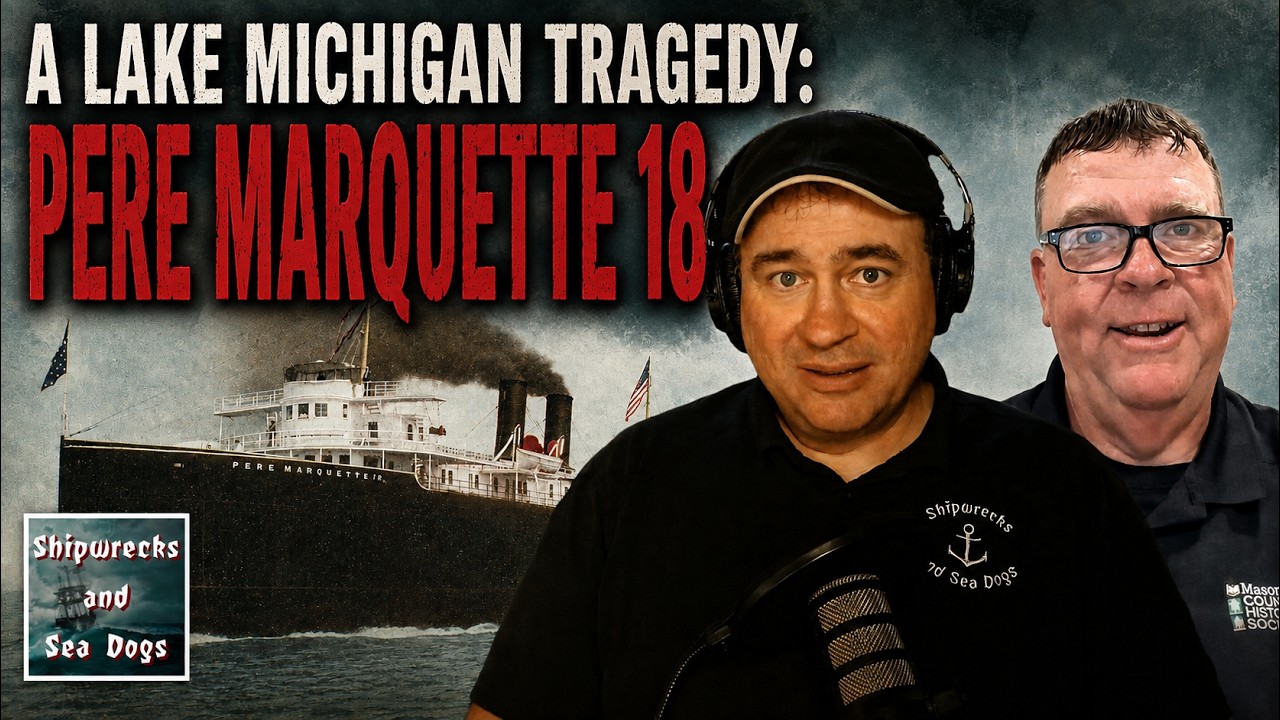
The rail car ferry Pere Marquette sank under mysterious circumstances in Lake Michigan in 1910.


In this episode of Shipwrecks and Sea Dogs, host Rich Napolitano sits down with Great Lakes historian Rob Alway to uncover the story of the Pere Marquette 18, the flagship rail car ferry that mysteriously sank in Lake Michigan in 1910. Rich and Rob explore how the Pere Marquette Railroad helped shape maritime and rail travel across Lake Michigan, why the Pere Marquette 18 was considered the fleet’s most notable ship, and what happened on her final voyage from Ludington to Milwaukee. Rob walks us through the theories behind the sinking, including possible hull damage from its excursion service, the emergency distress call that made Great Lakes history, and the rescue efforts that followed.
You’ll also hear about:
⚓The history of Ludington’s car ferry industry
⚓How railroad ferries helped avoid Chicago rail bottlenecks
⚓The aftermath of the sinking and the changes it inspired
⚓The wreck’s discovery nearly 500 feet down in Lake Michigan
⚓Why the SS Badger remains a living link to this maritime legacy
A perfect episode if you’re interested in Great Lakes history, shipwrecks, rail ferries, maritime disasters, or the hidden stories behind the places we live.
Read more of Rob Alway's work:
⚓Mason County Historical Society | https://masoncountymihistory.org/
⚓Mason County Press | https://masoncountypress.com
⚓Oceana County Press | https://oceanacountypress.com/
Listen now to learn how one shipwreck helped define an entire era of Lake Michigan travel.
🎧 LISTEN AD-FREE + BONUS EPISODES**
👉Shipwrecks and Sea Dogs is part of the Into History podcast channel. Subscribe here: https://www.intohistory.com/shipwreckspod
👉Get exclusive bonus episodes and merch on Patreon: https://www.shipwrecksandseadogs.com/patreon
👉Subscribe on Apple Podcasts: https://www.shipwrecksandseadogs.com/apple
👉Shipwrecks and Sea Dogs Merchandise is available! https://shop.shipwrecksandseadogs.com
👉You can support the podcast with a donation of any amount at: https://www.buymeacoffee.com/shipwreckspod
*No compensation or remuneration of any kind was paid to or paid by Rich Napolitano, Shipwrecks and Sea Dogs, or Nautilus Media LLC for Mr. Alway's participation in this episode.
** No AI was used to create this episode.
Written, edited, and produced by Rich Napolitano. All episodes, images, and sources can be found at shipwrecksandseadogs.com.
Original theme music by Sean Sigfried. https://www.seansigfried.com
Learn more about your ad choices. Visit megaphone.fm/adchoices
Hello, and welcome to Shipwrecks and Sea Dogs, Tales of Mishaps, Misfortune and Misadventure. I'm your host, Rich Napolitano.
Joining me today is Great Lakes historian, Rob Alway, to discuss the sinking of the railway ferry, Pere Marquette 18, in 1910. Rob, thanks so much for joining me.
Yeah, thanks, Rich. Thanks for having me.
Now, I introduced you as a historian. However, in actuality, you have a lot going on. You're involved with a lot of other things.
So I thought maybe you could explain that. So care to give us a quick bio?
Yeah. So I live near Ludington, Michigan, which is on the shore of Lake Michigan, about halfway up the state. And I am a full-time journalist.
I own an online newspaper, two online newspapers called the Mason County Press and the Oceana County Press. And through that newspaper, I do a lot of history writing.
I'm on the board of directors for the Mason County Historical Society, which operates the port of Ludington Maritime Museum. So I do a lot of the, I'm kind of the maritime guy lately for the Historical Society.
So I've been doing a lot of maritime research the last few years. Ludington is one of the great maritime ports on Lake Michigan. And so it's kind of something I just grew up with here.
And so it's always kind of developed an interest in history in general, but especially in maritime history.
Yeah. The Great Lakes area itself is just so rich with maritime history. And the people there like yourself are very passionate about it, as I found out.
So it's really great to have you here and be able to pick your brain and explore your knowledge about this topic, which I wasn't aware of until you made me aware of it. So thank you for that.
Oh, you're welcome.
Now, before we get into the Pere Marquette disaster itself, can you set the stage for the ship and the Pere Marquette Railroad, the car ferry service that was operating at the time?
Sure. So in the 1850s, a group of investors decided to build a railroad from Flint, Michigan, to Ludington. At the time, it was called Pere Marquette.
It was a village on the shoreline. It wasn't necessarily their destination, but it was one of the chosen destinations. Other options were Pentwater, which is just south of current Ludington.
Basically, the railroad finally reached Ludington in 1874. Ludington had become a city in 1873. James Ludington was a lumber man and renamed the village of Pere Marquette to the city of Ludington.
Ironically, James Ludington never lived in Ludington. He actually lived in Milwaukee, but owned thousands of acres. James Ludington was a rival to Eberbrock Ward, business rivals, and they had a lot of issues with each other.
And to a point where Ward, who was the president of the Flint and Pere Marquette Railroad, wasn't sure if he was gonna actually terminate the railroad in Ludington because of his issues with James Ludington, he actually ended up having James
Ludington arrested when James Ludington came to Detroit because of accusations that Ludington's people were stealing lumber from him, from Ward. And basically that ended up financially ruining Ludington, and he sold most of his interests to other
business people, which ultimately ended up making amends with Ward, who determined that that's where the Flint and Pere Marquette Railroad was going to end. And when they built the railroad, they had always knew that they were going to ship across
the lakes to Wisconsin. And at that time, they did not have actual rail service. So in 1874, the railroad ended in Ludington. By May of 1875, they started shipping freight across the lake.
It was called brake bulk chipping. They would basically remove the freight off the rail cars at the shoreline, load it up, and then they ship it for that first year to Sheboygan, Wisconsin.
By the next year, they decided that particular ship that they had leased was not big enough, and they started leasing with the Goodrich Line, which was a major shipper out of the Great Lakes, out of Lake Michigan, based in Chicago.
And Goodrich had actually three ships that were built specifically for the Ludington fleet. And so they continued breakbox shipping at that point to Milwaukee. And fast forward, in 1897, the first car ferry came to Ludington, the Pere Marquette.
The very first Lake Michigan car ferries were the Ann Arbor car ferries that were located in Frankfort, Michigan, for the Ann Arbor Railroad. And they began in 1892, and by 1897, the Flint and Pere Marquette Railway decided that was a very good idea.
And so they introduced the Pere Marquette, which was actually the first steel railroad car ferry as well.
From there in 1899, 1900, the Pere Marquette Railroad was formed, which was a combination of the Chicago and West Michigan Railway, the Detroit Grand Rapids and Western Railroad, and the Pere Marquette and the Flint and Pere Marquette Railroad.
And that's that formed the Pere Marquette Railroad, which lasted for 47 years until the CNO, the Chesapeake in Ohio, took that over.
So as the Pere Marquette Railroad was formed, they majorly expanded their railroad, their car ferry fleet, and they introduced the Pere Marquette 17, the Pere Marquette 18, the 19, and the 20.
And the Pere Marquette 18 is the ship that was the flagship. It had better passenger accommodations. And so basically that was the chosen ship, and that's who we're talking about today, is the Pere Marquette 18.
And it's into it.
So you said that it's the flagship. So what was special or notable in terms of its capacity or et cetera?
So all four of these particular ships, the 17, 18, 19, and 20 were all the same size. The 19 and 20 were basically completely freight ships. They didn't have any passenger accommodations.
The 17 had limited passenger accommodations, staterooms, but the 18, they had far more. Nothing like the modern day SS Badger that still exists, which is the end of the line of this car ferry fleet.
But it still had staterooms for passengers, and just the accommodations were a little bit nicer. And so it made it kind of the chosen ship as the flagship. And it was just the favorite of the fleet.
And Captain Peter Kilty, who was the Commodore of the fleet, that was his ship that he got assigned.
And so it was a railway car ferry. You know, it's not something that we often see today, is these railway cars being loaded onto ships, because the shipping just does that now. We don't need the railway cars, across waterways at least.
I imagine it was pretty dangerous work. What was it like perhaps for the crew or the workers that attended to the ship?
So these ships were designed to operate 365 days out of the year in Lake Michigan. And a lot of people, and I know you've talked about this several times in your various episodes. I mean, the Great Lakes are not lakes.
They are seas. And many people are surprised of the weather that they can encounter. The wave action on Great Lakes are different than they are on the ocean, which actually, to my understanding, I'm not a mariner.
I'm a maritime history person, but not a mariner. But my understanding that it actually makes for more dangerous conditions than actually operating on the ocean in many cases.
And a lot of sailors that have operated on the oceans that come to the Great Lakes are humbled very quickly and realize that they learn to appreciate and respect the lakes. But these ships were basically, they were built as icebreakers.
They could operate, like I said, throughout the year. And that's when their busy season was, was actually in the fall was the harvest time. And so they started shipping more grains in the fall and into winter.
And so that's when they needed the ships more. And that's actually significant to this story because the Pere Marquette 18 was actually not needed in the summertime by the car ferry fleet because they weren't as busy.
And because it had the better accommodations, they actually leased the ship out or chartered it out to excursion companies in Chicago to operate.
I know recently you posted something about the Eastland and it was the same type of thing that the, they would actually convert these car ferries into excursion ships to go between, like, Chicago and Waukegan, Illinois and Michigan City, Indiana,
So let's talk about the ship's final voyage.
We're talking about early September 1910. What was this voyage of the Pere Marquette 18 supposed to look like?
So the 18 had been on excursion through the summer and it came back over Labor Day weekend and it had passed inspection in Chicago before it came back to Ludington. Ludington, Chicago, modern day terms by car is about a four hour drive.
Ludington is about halfway up Lake Michigan, so it's probably a good nine hour trip by car ferry.
And it came back to Ludington and when it was used for excursion, they would cover up the rails so they could have dance floors and stuff on what we call the car deck, a big open deck on the bottom of the ship, about three stories high.
And so they immediately in Ludington converted it back to a rail ship. And the evening of September 8, the ship took off from Ludington on its way to Milwaukee, loaded up with cars, rail cars. That is one thing I want to point out.
When we talk about car ferries in Ludington, even though the SS Badger is now a automobile ferry, but that was a rail ferry. And when we say car, we mean rail car. And so when we talk about car ferries, most of the rail cars were loaded with coal.
So it weighted down the ship. I mean, these were big ships. They could handle that.
And it went underway. And it was about 11 o'clock when it left Ludington on September 8th. And it was a fairly calm September evening.
It was not high wave action. There was no storm. They got about halfway into the lake.
One of the men in the engine room went down into a room, what we affectionately in the car ferry business called the flicker. And the flicker was the room that is basically the quarters for the engine crew.
And they call it the flicker because these old car ferries, the lights would flicker a certain cycle. And so that's why they call it the flicker.
And he discovered about six feet of water down in that area aft of the flicker into the, past the engine compartment. And got a hold of the engineer who got a hold of the first mate. And they couldn't figure out why they were bringing in water.
And actually to this day, that's never been answered completely. There's a lot of theories. But again, they did not have high waves.
I mean, maybe two, three foot waves. It wasn't a very wavy evening. And they were about halfway into Lake Michigan.
And from Ludington, Milwaukee is about a six hour car ferry ride. And so they were about halfway, still north of Milwaukee. Milwaukee is southwest of Ludington.
If you're familiar with Michigan, it's directly across from Muskegon.
And so Captain Kilty, who was an extremely experienced captain, started ordering them to pump the water out and continue to make way toward, toward Milwaukee because they were about halfway out.
Something significant about the Pere Marquette 18 is the Pere Marquette ships were, this is 1910, but they were equipped with radio, with wireless radio.
And actually the Pere Marquette 18 was the very first car ferry to ever use CQD as a distress call on the Great Lakes.
Yeah, that's interesting.
Yeah, and this occurred two years before the sinking of the Titanic. And so after realizing that they were unable to get the water out, finally the captain ordered for the radio operator to send out CQD.
It was the policy of the Pere Marquette Railway to always have a ship. The ships, because there were six ships at that point operating, and the ships would always be within about an hour of each other at some point.
They were at that point traveling to Milwaukee and Manitowoc, which was, Manitowoc is currently still the port of call between Ludington and for the SS Badger.
And then also Kewanee, which is, so each of these ports about an hour away from each other by modern day car. So the Pere Marquette 17, which was in Milwaukee at the time, immediately made its way toward the Pere Marquette 18.
And the Pere Marquette 18, at this point, they realized they weren't able to get the water out of the ship. And the Pere Marquette 17 basically started to come about toward the 18.
And at that point, they were able to start getting people off the ships, but basically the 18 sunk right in front of their eyes. So 27 passengers and crew members, 18 crew members, and a total of 27 people from the Pere Marquette 18 died.
And then two crew members from the 17 died as the 17 was sinking. They were coming over on lifeboats to try to rescue, and their boat overturned and managed to kill them. But 35 people did survive, which was fairly significant as well.
Now, one of the things I was reading about, maybe this was one of the controversies you were alluding to earlier, was that some criticized the captain after the fact that he should have turned back.
But as you were saying, that they were roughly halfway across anyway. So what do you make of that?
Well, Kilty was an extremely experienced captain. And at the time, yeah, like I said, they were halfway back. So it really was kind of a crapshoot of what would happen.
And again, they could not find the source. I personally believe the theory that what happened was when it was on excursion. And by the way, Captain Kilty was not the captain of the ship while it was on charter down in Chicago.
And to my understanding, he was not a fan of leasing out his ship to another captain. And the way these car ferries, they're loaded on the aft compartment, but of course, they were able to load passengers from the side.
So these ships would come in and they would hit the dock. And there's a theory that it may have loosened up the bulkheads. And when the ship came back to Luttington and loaded with, it was a full load, with rail cars, with coal, etc.
in them, the ship lowered into the water level. And they believe that that's what actually caused the water to come in, was through these loose bulkheads in the ship.
There were some reports that water was coming in through the actual deadpans, but the most think that that was the case, that it loosened up basically the rivets and stuff on the ship. And that's what caused it to sink.
Yeah, that's what I was thinking about earlier, was when it was used as a passenger vessel, perhaps they were getting into some shallower water than it would otherwise.
So it's possible they could have banged up the ship a little bit, and not to the point where they would notice any water coming in. Because as you know, when it would be carrying the rail cars, it would be much heavier.
So the ship would ride a lot lower in the water, which could be where the damage was. Is that something that has been theorized as well?
Yeah, and that's really kind of my theory. Like I said, there was a... Early theories was that there was the broken dead light, but that wasn't enough to bring in the type of water that was bringing in.
And that's where the loose hull plates is the theory that most people accept.
Now, one of the things that came as a result of this, which I still don't really think, and I've even talked to some modern captains, and they don't really believe that this had anything to do with it, but the car ferry industry as a whole...
So there were basically three car ferry companies on Lake Michigan at the time, three railroads that operated car ferries.
You had the Ann Arbor Railroad up in Frankfurt, the Pere Marquette Railroad in Ludington, and then the Grand Trunk Railroad out of Grand Haven and Muskegon.
And they all got together and decided that they were going to put stern gates or sea gates, it depends on who you talk to, where you're at, on the backs of the ships. And that theory was that the sea gate would keep water from coming in.
But there's no evidence that the wave action caused this ship to sink. But that was a result of the sinking of the Pere Marquette 18 was actually putting sea gates in. But again, I really think that it was loosening of the bulkheads.
So let's talk about the aftermath then, in terms of public outcry or in the news and subsequent investigations, if any.
I know that there were some investigations and there was some limited blame on the captain, which is ultimately his responsibility.
But as far as Ludington goes, it's interesting. I mean, it certainly had impact on Ludington.
Kind of strangely, immediately after the sinking, the railroad ordered the building of another car ferry, which they actually re-named the Pere Marquette 18. So as a historian, it's always a little confusing as we...
I mean, it wasn't the Pere Marquette 18 No. 2 either. It was just the Pere Marquette 18.
And so, you know, obviously there were investigations, like I said, but the public outcry, it was just kind of accepted, I think, in the Great Lakes, you had accidents and shipwrecks.
Now, this was the first time the Ludington fleet had experienced sinking. There was actually, the year before, in Lake Erie, the Marquette and Bessemer No. 2 car ferry sank in a storm with all hands died.
And then the only other time a rail car ferry sank in the Great Lakes was the Milwaukee, which happened in 1929. Something kind of interesting is all three of these ships were sister ships. They were all designed by Robert Logan.
They were all built approximately the same time. They were all built on the same template.
They were all the same ship, which I find interesting that they were the only three car ferries on Lake Michigan to sink and they were all designed by the same person and all basically built by the same company.
So you did mention the way that they changed making the ships in terms of the stern gate. Were there any other changes in terms of manufacturing or perhaps safety regulations that came of this?
Not that I'm really aware of. I think most people kind of accept the theory of the bulkheads loosening up. And so, you know, the stern gate seemed to be the, for whatever reason, they decided that was the solution.
But I don't think it was the cause.
Was the captain killed in the accident or did he survive?
The captain killed, he did go down with his ship. Yes, along with all the officers. And that is something that did cause, you know, that was a challenge in the investigation, was all of the officers perished in the accident.
Right.
Because they would have the best chance of explaining what happened.
Correct.
Yes. Wow. So, how did that affect overall the Pere Marquette Railway Company in the coming years and decades perhaps?
Did they continue to thrive or what ultimately happened there?
So, following this, you know, like I said, the Pere Marquette 18 was built, the Pere Marquette 18 number 2 was built pretty quickly after that. And from there, the fleet actually expanded within a few years.
In the early 1920s came the Pere Marquette 21 and the Pere Marquette 22. In the early 1930s, the city of Saginaw 31 and the city of Flint 32 were introduced.
And those, they changed their pattern because up to that point, the railroad just basically named them by numbers. And they changed that pattern to kind of pay tribute to Flint and Saginaw, which were significant, you know, parts of the railroad.
And then in 1940, 41 came the city of Midland 41. And the reason why that ship was named city of Midland was kind of in honor of Dow Chemical, which was a major supplier for the railroad service.
And then in the 1950s, in 1952, you had the SS Spartan. And then in 1953, you had the SS Badger. And they were the last two.
And all of these ships were coal fired. And even though the coal fired ships started to change in the mid 20th century, but these ships were by this point owned by the Chesapeake and Ohio Railroad.
And so they, which, of course, they hauled a lot of coal. So they continued to operate with coal.
Yeah.
And one of the things, too, that I want to mention, the reason why this rail service was so significant was because in the late 19th century, early 20th century, rail traffic through Chicago was just a major bottleneck.
And the Flint and Pere Marquette Railroad being the first one, and then the Ann Arbor Railroad were, you know, they saw the value of being able to cut a lot of that time of traveling through Chicago.
And even to this day, now with the SS Badger operates, you know, a lot of commercial traffic, you know, trucks that will take the Badger across to avoid Chicago. But to kind of follow up with your question about the railroad striving.
So at one point, there were seven working car ferries that operated out of Luttington, going to Milwaukee, Manitowoc and Keewanee. And that lasted until the 1950s.
And then, as the, when the CNO began merging with the BNO and the Baltimore and Ohio Railroad, the Baltimore and Ohio Railroad had significant interest in Chicago.
And they were able to basically make the traffic flow, railroad traffic flow in Chicago a lot more efficient.
And by the 1960s, the CNO decided, you know, came to the conclusion that Cross Lake Ferry Service was probably no longer feasible, and started to make efforts to close down those services.
And the same thing with the Grand Trunk, by that point, based out of Muskegon, and then the Ann Arbor in Frankfort. Ludington was a car ferry town.
At one point, I've heard the statistic about 5% of our population in our county worked for the railroad, which included the boats. And probably, as you know, this Rich, in the Great Lakes, we call them boats. We don't call them ships.
And so they worked for the boats. And so it was a big deal to see the demise. By the early 1970s, there were only three car ferries operating, which was the City of Midland, the Spartan, and the Badger.
And then by 1980, there was just one, which was actually the City of Midland, that operated. And the CNO had basically won a federal permission to abandon the railroad, abandon the car ferries by that point.
And so a local company took over called Michigan-Wisconsin Transportation, and it was owned by a couple of Ludington businessmen, Glenn Bowden and George Towns.
And they continued to operate the City of Midland, originally operated rail service across to Kewanee, which is north of Manitowoc.
They attempted to do summer service with the Badger, going back and forth to Milwaukee, but it only lasts a couple of seasons.
Michigan-Wisconsin Transportation operated the City of Midland until 1988, and then the Coast Guard basically determined that the City of Midland was not repairable. And so they switched over to the Badger, which was actually a newer ship.
And the reason why the Badger was chosen over its sister ship, the Spartan, was because in the 1960s, the Badger was raised about 18 inches to accommodate rail cars that the auto industry needed for bigger car, for bigger automobiles to transport
them on rail. And so the Badger, a lot of people talk about 18 inches saved the Badger, because the Badger was the chosen ship. But that only lasted a couple of years, and Michigan-Wisconsin Transportation went bankrupt in 1990.
And a gentleman who at that point lived in Holland, Michigan, named Charles Conrad, came in, and he was an entrepreneur. He was born and raised in Ludington.
His dad was a chief engineer on the car ferry fleet, and he actually worked for the car ferries as a young teenager.
Charles Conrad was very successful, operated a refrigeration company, and that refrigeration company started having contracts with NASA in the 1950s and 1960s, and made him a multimillionaire.
And Charles Conrad decided to buy the boats, and he had a vision to continue the service, and basically he said if it would take every penny he had, he would save the car ferries.
And so the first step was to revitalize the Spartan and convert it from a rail ship to a automobile transporting ship, and put more emphasis on passenger service. And so the Badger in 1992 began to sail again and continues to sail to this day.
Conrad formed a company called Lake Michigan Car Ferry, which Lake Michigan Car Ferry was finally sold from Conrad's family in 2020 to Interlake Maritime Services, which is the largest commercial.
You know, they run the largest freighter fleet in the Great Lakes, and they continue to operate it to this day.
And the Spartan is no longer operating, just the Badger?
So in 1978, the Spartan was shut down. There was an attempt by the state of Michigan to lease the Spartan and move it to Frankfurt to operate for the Ann Arbor Line, which was basically on its last leg.
But they determined the Spartan, the harbor, Betsy Bay, where the Ann Arbor fleet operated was too shallow for the Spartan. And so the Spartan in 1978 was laid up and hasn't operated since.
But however, the Spartan has served a purpose because it is a duplicate of the Badger. And locally, they call it shopping at the Spartan because if they need a part, they go get the part off the Badger. And last year is actually pretty significant.
There was an issue with the telegraphs on the Spartan or on the Badger, which caused it to inadvertently run into the bow of the Spartan and dented the sea gate to the point where it totaled it. And so they had to take the sea gate off the Spartan.
And the city of Midland actually in the 1990s was converted to a barge, which still operates by the same company.
At that point, Lake Michigan Carferry formed what they called Pere Marquette Shipping, and it operated freight with the barge and a World War II tug called the Undaunted. And they renamed the city of Midland to the Pere Marquette 41 barge.
That entire operation got sold to Interlake Maritime Services, and it still operates as well, based out of Ludington.
But many people will say that that operation actually helped save the Carferry, you know, the Badger, because it was able to supplement an income for the company as well.
These ships, or I'm sorry, these boats seem probably ordinary to people in the area, you know, you're used to seeing them.
But we're talking about these boats that are decades and decades old, and it takes a lot of work and a lot of effort to keep them operating, to maintain them properly. The Coast Guard's pretty strict with those things these days.
So if they're not safe, they're going to get shut down.
The Badger, it is an operating coal-fired steamship. I believe that there are actually three steamships, maybe in the world, I believe, that still operate coal-fired steamships.
But this is the only one that actually works as a commercial vessel to this day. And there is a lot of conversation about converting her either to diesel or continue as a steamship, but possibly using a different fuel source.
But it is a working museum, basically. Many components of the Badger continued to operate the way it has since 1953. They still use the telegraphs, they still use the voice operated telephones on the ship.
And of course, they have modern radar and AIS and GPS and so on and on there. But she's over 70 years old and they take very good care of her.
And I know that the company right now, they have been in the process of basically rebuilding the staterooms every winter. It goes into layup and they rebuild a little bit of the ship piece by piece over the years.
It's pretty interesting to me that it's still a coal-fired ship, being that obviously if you think back to the old steam ships or even the old locomotives, that's just billowing this black smoke into the air.
So has that been any kind of issue with the local communities for pollution reasons?
You know, of course over the years, there's been some development and we've built marinas around the car ferry and we have sometimes some boat owners are a little surprised that their boats get coal dust on them.
Back about 15 years ago, there was some controversy, and some of it rather political, about the car ferry dumping coal ash in Lake Michigan.
And Lake Michigan is an extremely large body of water and I'm not defending dumping coal ash or anything into the lake.
When you think about the history of shipping and how at one time all of these ships, hundreds of them on Lake Michigan or the Great Lakes operated coal and they did this.
But what happened was we had about 20 years ago, a high speed car ferry service started from Milwaukee to Muskegon and they had some political connections and higher up into the Senate and they convinced the Senator that they needed to fight this
battle. But as a result of that, the car ferry service adapted and they created a way to capture the coal ash on the ship and then remove it and dispose of it in a more environmentally friendly way.
They do have waivers from the EPA to operate the Badger. It is a historic landmark registered as a national historic landmark. The Badger has been honored by the Steamship Historical Society.
But again, I do know that it is something that the company has been investigating of converting her either way. But I know that many people want to save the engines, the working engines.
They are the last of their kind anywhere in the world that most people are aware of, the Skinner Triple Expansion engines.
How many trips does the SS Badger make across the lake every year?
So, the Badger operates from mid-May to mid-October. And beginning of the season, up until early June, they make one trip a day across to Manitowoc and back.
And then in the summer season, basically June to early September, they'd make two trips back and forth. And so, it's a four-hour trip, and four hours across to Manitowoc, there's about a two-hour layover, and then comes back, and it's non-stop.
And they transport, the ship itself can transport about 600 passengers. I think on the average, they will hit about 400 passengers.
And I can't remember offhand how many vehicles, but it can handle a lot of automobiles, but it can also handle large freight.
For several years, when the wind turbine business was really booming, they would actually transport wind turbines on the Badger.
You know, it's a 410-foot ship, and it's almost 400 feet of empty car deck space down below, which is about three stories tall. It can handle a lot of commercial vessels and vehicles as well.
Now, turning back to the Pere Marquette 18, is the location of the shipwreck known? Okay, and what's the condition, and how deep is it?
So, in 2020, shipwreck divers discovered the 18. It's about 20 miles off of Sheboygan, Wisconsin. It's about 500 feet on the floor, Lake Michigan, 500 feet deep.
I believe that the deepest part of Lake Michigan is about 800 feet, so it's pretty far down there. It is standing almost upright, stern first, in the lake bottom. The island house is separated from the ship.
Lifeboats and wreckage are still scattered nearby. So it's in pretty good condition, to my understanding.
You know, those freshwater, cold water shipwrecks tend to stay in better condition than the saltwater ones, that's for sure.
They do, yeah.
And as far as diving on the wreck, is it allowed? Is it a popular site?
I'm not too sure about that. You know, it's 500 feet down, so it's obviously, you know, going to require some pretty significant equipment.
Yeah.
It is not a protected sanctuary area at this point, I believe. I know that there's been more efforts in the Great Lakes to create some sanctuaries and some shipwreck diving, you know, sanctuaries.
But I'm not aware of that because I think it's still too soon. I mean, it's only been six years since they found it, so that hasn't quite been resolved yet.
Oh, yeah, that makes sense. And it's always a delicate situation when there's, when there were deaths on board. And there usually are deaths.
But yeah, like you said, 500 feet down, that's going to be somebody only an experienced technical diver would try to take on, I'm sure. What about artifacts from the Pere Marquette 18? Has anything been recovered or perhaps in a museum somewhere?
Not really any artifacts.
I do know that there are some private collectors who have some of the actual telegraphs that went back and forth. So that's kind of something interesting that's currently in private collection.
And that's something I want to mention talking about the telegraph. And this gentleman's name is very hard to pronounce. Stephen Shepenak, he was the purser on board.
The Great Lakes ships didn't have Marconi operators. They were actually just employees, but he was also the wireless operator. And like I said, he was the first person ever use a distress signal on the Great Lakes.
And there's actually a memorial in New York City for wireless operators who died on ships. And his name actually sits right next to the operator from, or Phillips, Mr. Phillips from the Titanic who died using the stress signal on the Titanic.
So it's kind of an interesting connection with the Pere Marquette 18 and the Titanic.
Are there any memorials or monuments to those who died on the Pere Marquette somewhere in the local area?
Yes, there are several in in Luttington.
So the Port of Luttington Maritime Museum, which is located in a beautiful former Coast Guard station right on the channel in Luttington, actually pays significant tribute to all the car ferries, but we do have a Pere Marquette 18 exhibit.
Stearns Park Beach, which is located just near the Maritime Museum, actually has an official State of Michigan historical marker that pays tribute as well. And so there's quite a bit of the story of the Pere Marquette 18.
You know, it's the only only car ferry in Luttington that sank, and out of all the ships, I believe there were a total of about car ferry and pre-car ferry vessels. There were about 30-some ships that operated.
And pretty significant that out of all of those, that was the only shipwreck, you know, to come out of that fleet. That's pretty good track record. Yeah.
So it was a big deal. And yeah, we do obviously pay tribute to that in our town.
And before we started recording, you told me that the painting behind you on your screen is of the Pere Marquette 18 sinking.
It is, it's a depiction, an artist's rendering of that based on witnesses.
There's actually been quite a bit written about, because we were lucky to have several survivors and through the years gave newspaper interviews about their story, which is where I got most of my story based on those newspaper accounts, but they were
based on quotes from actual survivors. So that's kind of where this came from, is this painting that we have at the Mason County Historical Society, and I believe that this is the original painting behind me that was drawn, and it was used many times
You mentioned your article that you wrote about this shipwreck.
That would be a great source for anybody listening that would like to dig into the grittier details, perhaps, of all of this. I'm sure we're just hitting the highlights here. Where can everyone find that and read it?
Sure.
You can find that at masoncountypress.com. And if you do a search for Pere Marquette 18 in the website, you can find it. There's also a drop down that under features that it's called the Great Lakes history log that I write.
Most of my maritime or most of my history stories are related to the Luddington area, but I do delve into some other Great Lakes history.
You and I, we've crossed stories a few times, which has been great to see your podcast about what I've written back and forth. I certainly always welcome people to look at my article and tell me I was wrong in a certain area.
I don't claim to be the greatest expert.
There are many people that have come before me that have done a lot of history research in Ludington's Maritime History and I feel like I'm kind of the next one of the next people in line to take that over for a few years until the next people come
That's why we tell these kind of stories is to keep the memory alive.
And tragically, a lot of these stories are forgotten. They've just been passed by by history and nobody's aware of them. And I think it's important because the people on them were real people.
They're not just ink on a page. And it's important that they are remembered even just on a small scale. So that's why I do this and I'm sure that's why you do what you do.
So thank you for that.
I agree. I think their stories deserve to be told, especially the maritime industry. These people sacrificed a lot.
I mean, the one nice thing about the car ferry industry was a little unique compared to even in modern times is a lot of these men were able to come home at night or at least, you know, a few times a week.
Even to this day, on the Badger, the licensed crew lives on the ship during its full time, you know, when it does what they call doubles.
They don't necessarily see their family all the time, but they do get to see them more frequently than, you know, the mariners who operate on the freighters. And that's been kind of a, that's a unique part of this particular industry.
Yeah. Yeah. Those, those Lakers, if I, if I can use that term.
Yep.
For example, like the Edmund Fitzgerald, you know, they were, they were ore carriers and they'd be gone weeks at a time.
Yeah. It's a much different life than being able to come home every day.
Absolutely. And, you know, that's something that's important to me too, Rich, because I, I'm a journalist also, you know, and I run an online newspaper and we, we're a local newspaper, a small town.
But I believe that as a journalist, I'm a, I'm a historian. I mean, what happened yesterday is history. And so it's important to me, the Badger continues to operate here.
We have the undaunted Pere Marquette 41, Tug Barge, and I, I love telling their stories about the modern crew, you know, because that, that eventually will be history, that the next people that take over for you and I will, will be able to reference
that material. And I think their, their stories are important to tell because it's, it's a legacy that continues on in our town. You know, we, we're still a shipping town, you know. So we, it's, it's an important draw.
I mean, we still have a lot of boaters here, and we still do some commercial traffic as well.
And, and these kind of stories where it doesn't have the, the massive death toll that the Titanic had or the Lusitania or any, really a lot of them, the Eastland.
But that doesn't really matter because it's still a loss of life, and it's a loss of livelihoods for, for those people's families. It's detrimental in a lot of ways.
And these smaller stories, if you will, or, you know, from the smaller towns or the lesser known stories are just as important to me as the more well-known stories. You know, everybody asked me about the Titanic.
And I haven't done an episode about the Titanic, and it's not because I have anything against the Titanic. It's just that it's so well-known. It's been told so many times.
I mean, who hasn't seen the movie Titanic, which I know is not, it's not a documentary. But you get the gist of it. So it's not that it's not important.
It's just everybody knows it already. So I feel like there's a higher priority to tell these stories that are not as well-known.
It's funny you mentioned the Titanic. You know, and I always like to tell, how does it impact my local audience in little Ludington, Michigan? And I don't know about you, but I like to wander through cemeteries.
And I get ideas from cemeteries. I find a grave, and I'm like, that's kind of unique. And I was in the what we call Lakeview Cemetery in Ludington back in October, and I came across a grave, and it said, Ida Anderson died in the Titanic.
And I'm like, what is this? And I started looking into it, and again, being a small town, very quickly found out who put the gravestone there, and come to find out there was this gentleman's great aunt who died in the Titanic.
And she was coming here to marry her brother-in-law, his grandfather, because his wife, her sister had died, and they had seven children. And she was coming from Sweden to marry him, and to help him raise his children. And she died on the Titanic.
And so I dug into that story, because it's a local, hyper-local story about the speech. Everybody knows the Titanic story, but nobody knows Ida Anderson's story.
And that's really interesting, especially to your local readers. That'd be really fun to read, because that person probably still has family in the area, I assume.
Oh yeah, and there are still several people who are related to this woman. I've actually done some local speeches. We do a speaker series, our historical society, and I packed the room.
Because everybody loves the Titanic story anyway, but then to have a local story and then relatives came, which was a little intimidating when you're telling a relative story, that this has been their family lore for 100 years and now I'm telling
them their story. But it's a fun topic to research. There are several Michigan connections to the Titanic. The president of the Grand Trunk Railroad, who owned one of the car ferry operations, died on the Titanic.
Charles Hayes was his name. And he was a guest of the president, I believe, of the Pennsylvania Railroad. And he and his family just happened to be traveling in Europe.
And through the Ismay connection, because they all knew each other, he switched ships to get on the Titanic. That typical story. Switched ships to ride the Titanic for the first time.
And he's actually, Charles Hayes is quoted in several of the Titanic books. More of the credible historians who've written, you know, they've told Charles Hayes' story.
And so that's another interesting one, because he was based out of Muskegon and Milwaukee.
Well Rob, how can everybody reach you or follow you in all of your endeavors? What kind of things would you like to plug here?
Sure. So my website that I write every day, which does include a lot of local news, but also includes Great Lakes history, is called masoncountypress.com.
And you can also find some of my stories on the Mason County Historical Society website, which is masoncountymihistory.org.
If you go to masoncountyhistory.org, you're going to go to a completely different Mason County somewhere else in the United States, which is, as we always say, is a wonderful historical society as well.
And then you can also follow me on, I am on Facebook, on Mason County Press Facebook page. I do put up a lot of the stories on the Port of Ludington Maritime Museum Facebook page as well, a little less in depth.
And so that's pretty much where you can find my stories. Eventually, I'm going to be, I'm in the process of researching and writing a book on the captains of the Carfary Fleet.
I've got about a spreadsheet of about 76 captains, and I've been researching their history. And eventually, I'll go into a book form.
Oh, well, that's quite a lot. You're a very busy guy.
Yeah, oh yeah.
Well, Rob, thank you so much for joining me. It was really a pleasure to talk to you face to face finally. And I have a feeling that we'll probably be talking again about some other event sometime.
Sure.
Well, thanks, Rich.
Shipwrecks and Sea Dogs is written, edited and produced by me, Rich Napolitano. Original theme music is by Sean Sigfried. You can find transcripts, show notes, and show merchandise at shipwrecksandseedogs.com.
If you enjoy Shipwrecks and Sea Dogs, you can do me a huge favor by leaving a five-star review on Apple Podcasts, Spotify, or wherever you listen to podcasts. Please join me again next time. But until then, don't forget to wear your life jackets.


